
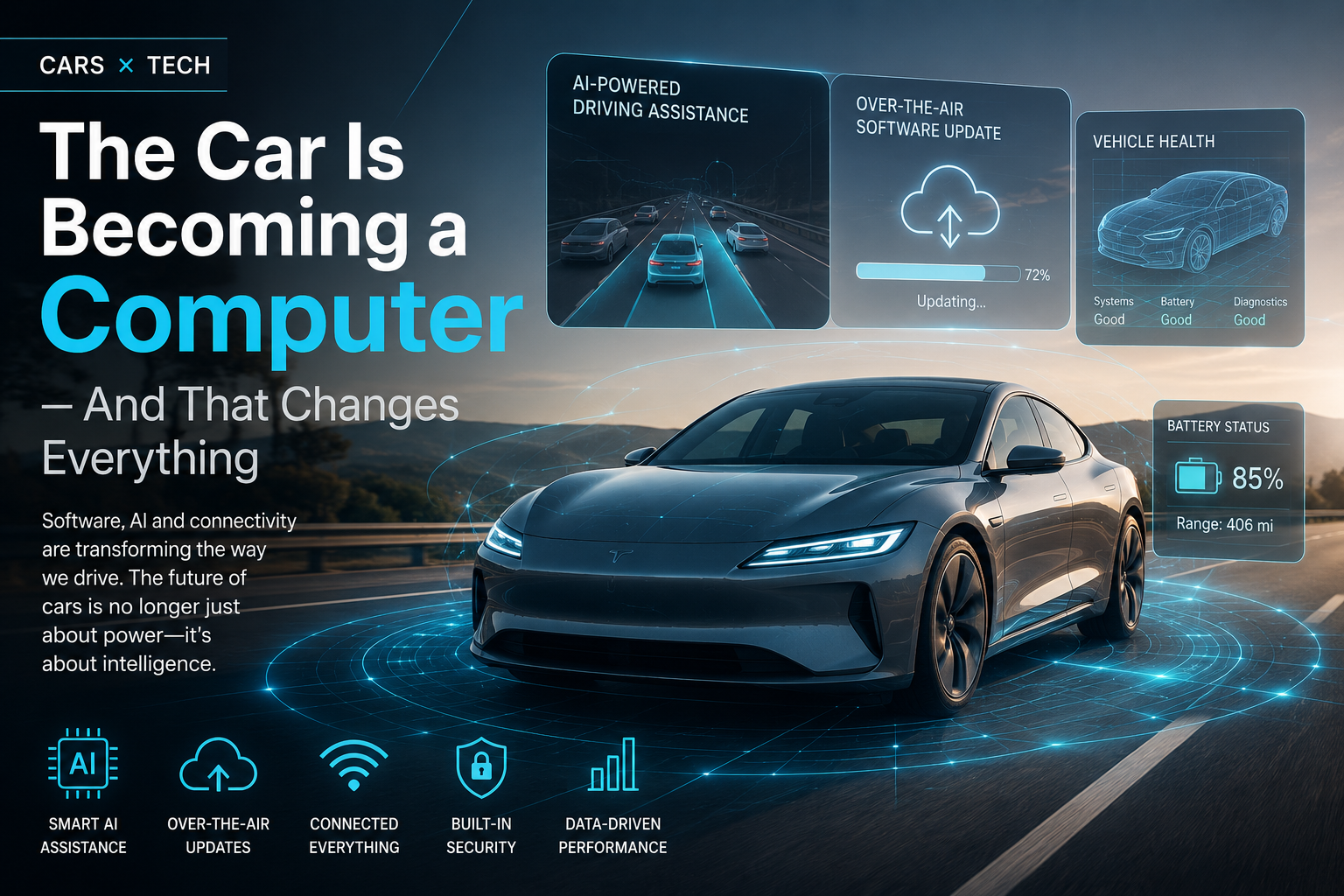
Cars used to be defined by horsepower, engines and mechanical engineering. The next generation may be defined by software, artificial intelligence and the ability to evolve after you buy it.
For more than a century, the basic idea of a car remained remarkably consistent. You bought one. You drove it. You took it to a service center when something went wrong. That model is beginning to change.
Today’s most technologically advanced cars are increasingly becoming software-defined vehicles — machines in which software controls an ever-growing share of the vehicle’s functions and can be updated throughout its lifetime. In other words, the car you buy today may not be the same car you have three years from now. And that’s both incredibly exciting and slightly complicated.
The “Computer on Wheels” Is Finally Here
We’ve been calling cars “computers on wheels” for years.Now, that description is becoming much more accurate.
Modern vehicles can already handle tasks that once required constant driver input. Adaptive cruise control can maintain distance from traffic. Lane-assistance systems can help keep a vehicle centered. Cameras and sensors can monitor the surroundings, while increasingly sophisticated software processes enormous amounts of information in real time.But the biggest change isn’t necessarily what the car can do today. It’s what manufacturers can potentially add tomorrow.
Software-defined architectures allow manufacturers to deliver updates remotely, much like updating a smartphone. The International Energy Agency notes that software-defined vehicles can receive improvements to features such as driver assistance and battery management through over-the-air updates.That changes the traditional definition of a car.
AI Could Become the Most Important Feature in Your Car
The next major leap is artificial intelligence. Today’s driver-assistance systems are generally designed around specific tasks: maintaining speed, keeping a vehicle in its lane, detecting obstacles or helping with parking. AI has the potential to make these systems considerably more context-aware. Instead of simply recognizing a vehicle ahead, an AI-powered system could potentially interpret a much broader situation:
- A pedestrian standing near the road.
- A vehicle behaving unpredictably.
- A construction zone.
- An approaching emergency vehicle.
- A complicated intersection.
- A sudden change in traffic flow.
Researchers are increasingly exploring vehicles that combine information from cameras, sensors, vehicle systems and contextual information to make better decisions.